Cats evolved as desert hunters with a weak thirst drive, and most modern cats live in a state of mild, chronic dehydration — especially on dry food. That matters, because concentrated urine is the raw material behind the two problems we write about most on this site: urinary crystals and blockages, and the kidney disease that afflicts so many senior cats. A water fountain will not fix any of this on its own, but it removes one friction point: many cats genuinely drink more from moving water, and the market has noticed — in our November 2026 scan of Amazon search results, stainless steel fountains held most of the top slots in the pet-feeding category.
We compared the most widely bought cat water fountains against the criteria that actually matter: material safety, filtration, pump noise, cleaning effort, and capacity. Our top overall pick is the Veken C1 Stainless Steel Fountain (108oz) for its full stainless build, quiet pump, and enormous owner base. If you want the same idea for less, the Neareal 74oz Stainless Fountain is our best-value choice.
A note on ratings and prices: The star ratings, review counts, and prices below are snapshots from Amazon listings at the time of writing (November 2026). Always check the current price, rating, and availability before buying. This article contains affiliate links, which means we may earn a small commission at no extra cost to you. Our picks are chosen independently, and brands do not pay for placement.
How We Chose the Best Cat Water Fountains
- Material. We favored food-grade 304 stainless steel over plastic. Stainless does not scratch the way plastic does, scratches are where biofilm and bacteria colonize, and it holds no odors. It is also dishwasher-safe in most of these designs.
- Filtration. Every fountain here uses a replaceable carbon (usually carbon-plus-felt or carbon-plus-ion-exchange) filter. Filters matter less for “purifying” tap water than for keeping the fountain itself clean and odor-free — which is what keeps cats drinking.
- Pump noise. A fountain that hums, rattles, or gurgles loudly gets unplugged within a week. We weighted owner reviews heavily for long-term noise complaints.
- Ease of cleaning. This is the real make-or-break. Fountains need full disassembly and a scrub every 1–2 weeks. Simple pump designs with few crevices score far higher than “smart” fountains with app-controlled extras that are hard to take apart.
- Capacity and stability. 2–3 liters covers one to two cats for several days. A low center of gravity and non-slip base matter for cats that paw at their water.
Cat Water Fountain Comparison
| Fountain | Material | Capacity | Approx. Price | Amazon Rating | Best For |
|---|---|---|---|---|---|
| Veken C1 Stainless | Stainless steel | 108 oz / 3.2 L | $28 | 4.3 (6,500+) | Most cats, multi-cat homes |
| Neareal Stainless | Stainless steel | 74 oz / 2.2 L | $20 | 4.4 (13,000+) | Best value stainless |
| PETLIBRO Wireless Pump | Stainless tray + plastic body | 74 oz / 2.2 L | $17 | 4.3 (1,000+) | Easiest deep cleaning |
| Veken C1 Classic | BPA-free plastic | 95 oz / 2.8 L | $20 | 4.3 (44,000+) | Tightest budget |
Top 4 Cat Water Fountains of 2026
 Top Pick
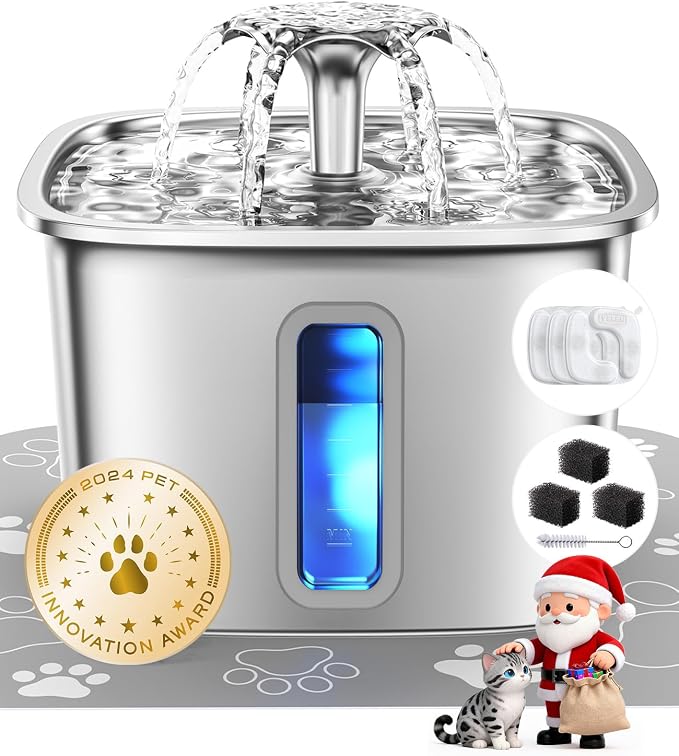
Veken Innovation Award Winner Stainless Steel Cat Water Fountain (C1, 108oz)
Best For: Most cats, multi-cat homes, hygiene-focused owners
Material: 304 stainless steel
Capacity: 108 oz / 3.2 L
What We Like
- Full stainless steel construction resists biofilm
- Visible water-level window with LED
- Quiet pump with adjustable flow
- Large 3.2L capacity suits multi-cat homes
- Established brand with easy filter availability
What We Don't Like
- Higher price than plastic models
- Filters need monthly replacement
- LED window unit adds a part to clean
The Veken C1 Stainless is our top pick because it commits fully to the material that matters. Where many “stainless” fountains are plastic bodies with a steel tray, the C1’s tank is stainless throughout — fewer scratches, no plastic odor, and a tank that goes straight into the dishwasher (the pump, as with every fountain, washes by hand). The water-level window with its blue LED makes it obvious at a glance when a refill is due, which sounds minor until it is the reason a fountain never runs dry.
The pump is the standard low-voltage submersible design Veken has iterated on for years, and owner reviews consistently describe it as quiet enough for a bedroom. The 108-ounce capacity genuinely covers a two-cat household for two to three days, and because Veken sells replacement filters by the multipack, ongoing costs are predictable. It costs more than the plastic classic below; you are paying for hygiene you can actually maintain.
 Best Value
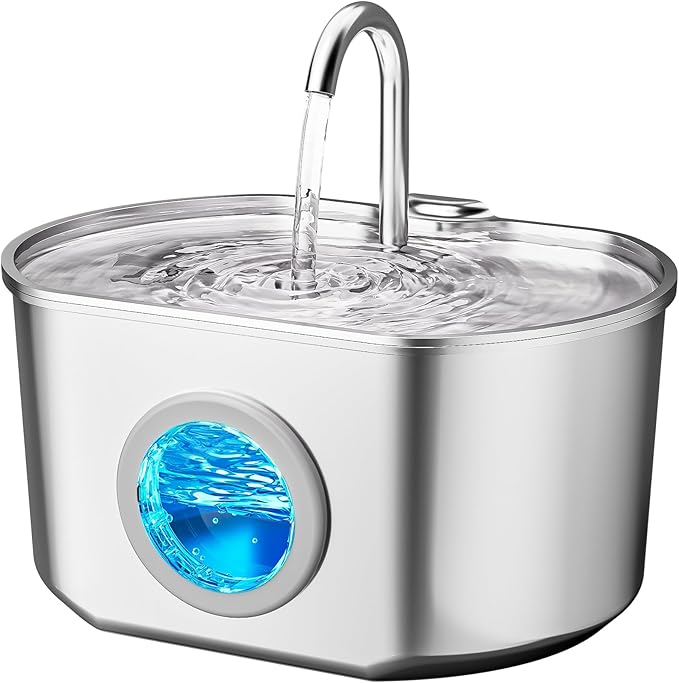
Cat Water Fountain Stainless Steel (Neareal, 74oz/2.2L)
Best For: Single-cat homes, first fountain buyers
Material: Stainless steel
Capacity: 74 oz / 2.2 L
What We Like
- True stainless build at a budget price
- Faucet-style spout many cats prefer
- Transparent window makes level checks easy
- Huge review base confirms reliability
- Simple three-part disassembly
What We Don't Like
- 2.2L needs refilling more often in multi-cat homes
- Pump longevity mixed in reviews
- No flow adjuster on some batches
The Neareal 74oz Stainless Fountain is one of the most visible fountains in the category — in our November 2026 scan, the generic “Cat Water Fountain Stainless Steel 74oz/2.2L” listing held two of the top three slots in an Amazon search for automatic feeders, and the review volume (13,000+) suggests it earns that visibility. One honesty note: like most fountains at this price, it is a white-label design, and the identical fountain is sold under several brand names (GIOTOHUN and others carry near-twin listings, one with over 23,000 reviews). Our link goes to the Neareal listing we verified; buy whichever version offers the best price and Prime shipping. The design is simple: a stainless tank, a faucet-style spout that mimics running tap water (a pattern many faucet-drinking cats prefer), and a visible window so you never guess at the water level.
Its weakness is the same as every fountain at this price: the pump is a consumable. A meaningful minority of reviews report pumps weakening after six to twelve months, so treat a replacement pump (they are inexpensive and interchangeable) as part of the ownership cost. For a first fountain, or for a single cat, this is the best value in the category.
 Easiest to Clean
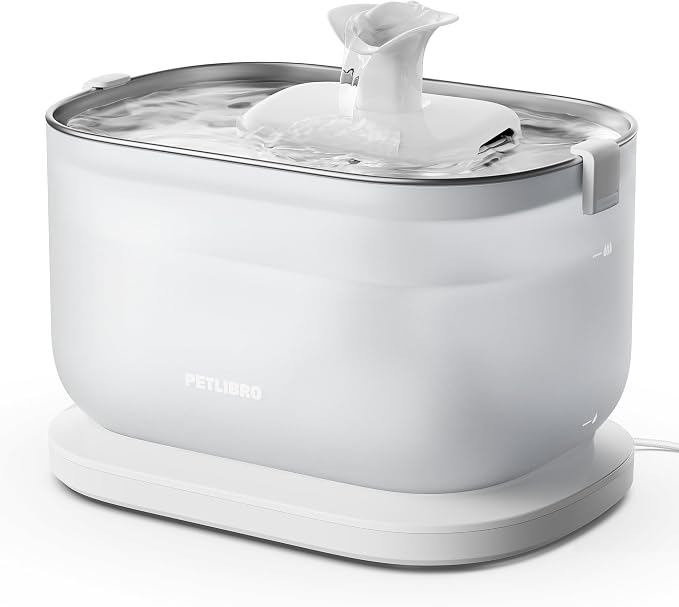
PETLIBRO Cat Water Fountain with Wireless Pump (Stainless Tray, 74oz)
Best For: Owners who hate cleaning pumps, design-conscious homes
Material: Stainless tray + plastic body
Capacity: 74 oz / 2.2 L
What We Like
- Wireless pump lifts out with no cord fuss
- Stainless drinking surface
- Ultra-quiet operation
- Low-water auto shut-off protects pump
- Very competitive price
What We Don't Like
- Body is plastic, not full stainless
- Smaller review history than Veken
- Replacement filters are brand-specific
The PETLIBRO’s headline feature sounds like a gimmick and is not: the pump is wireless, sitting in the tank on its own charge rather than tethered by a cord threaded through the housing. When cleaning day comes, you lift it out with no cable wrestling, no dried slime around a cord port, and no questions about whether the seal will leak when you reassemble. If you have owned a corded fountain, you know exactly how much friction that removes — and friction is what kills fountain-cleaning habits.
The drinking surface is stainless, though the tank body is plastic. Operation is quiet, and the pump shuts off automatically when the water runs low instead of grinding dry. We rate it below the full-stainless picks on material, but for cleaning convenience it is the best design here.
 Best Budget
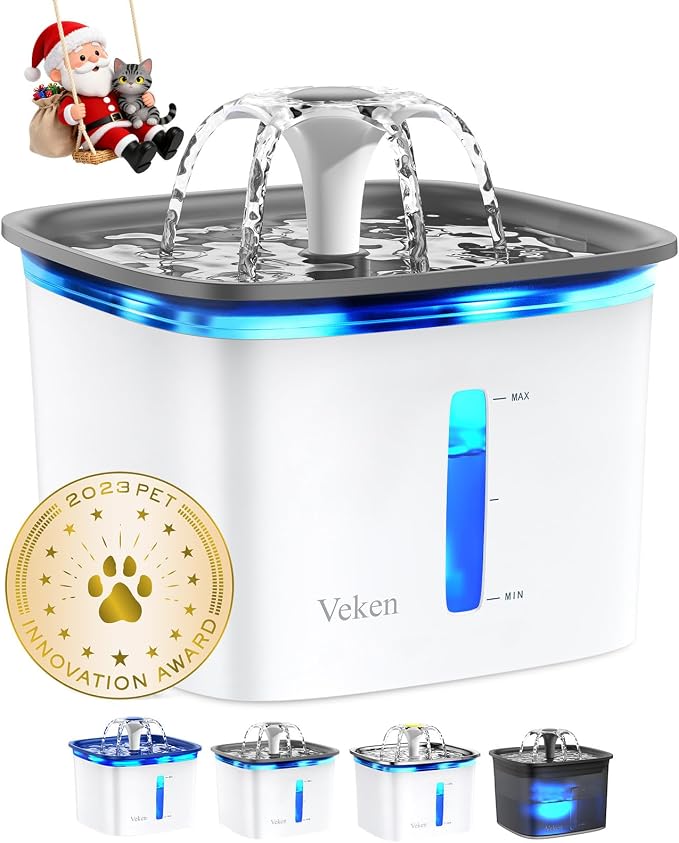
Veken Innovation Award Winner 95oz/2.8L Cat Water Fountain (C1 Classic)
Best For: Budget buyers, multi-pet homes testing the concept
Material: BPA-free plastic
Capacity: 95 oz / 2.8 L
What We Like
- Enormous 44,000+ review base
- 3 flow modes (flower waterfall, bubble, gentle)
- 2.8L capacity
- Inexpensive replacement filters
- Proven long-term parts availability
What We Don't Like
- Plastic scratches and holds biofilm over time
- Needs more frequent deep cleaning
- Pump noise increases with age in some units
The Veken C1 Classic is the category’s review-count leader on Amazon (44,000+ ratings — the largest base of any cat fountain we found), and it is the model that created the category’s modern template: transparent tank, three interchangeable flow tops, carbon filtration, and a $20 price. Nothing about it is fancy, and everything about it is proven. If you are unsure whether your cat will drink from a fountain at all, this is the cheapest way to run that experiment — and if it succeeds, you can upgrade to stainless later with your cat already converted.
Its limits are the limits of plastic. Scratches accumulate, biofilm clings to scratches, and the C1 rewards owners who scrub it weekly without exception. Some units develop pump noise with age, though replacement pumps are cheap and plentiful. A perfectly good fountain — with more demanding hygiene homework than our stainless picks.
Do Cat Water Fountains Actually Work?
Honest answer: for most cats, yes; for some cats, no effect; and for a few, the fountain itself is the problem. The evidence is a mix of physiology and practical observation:
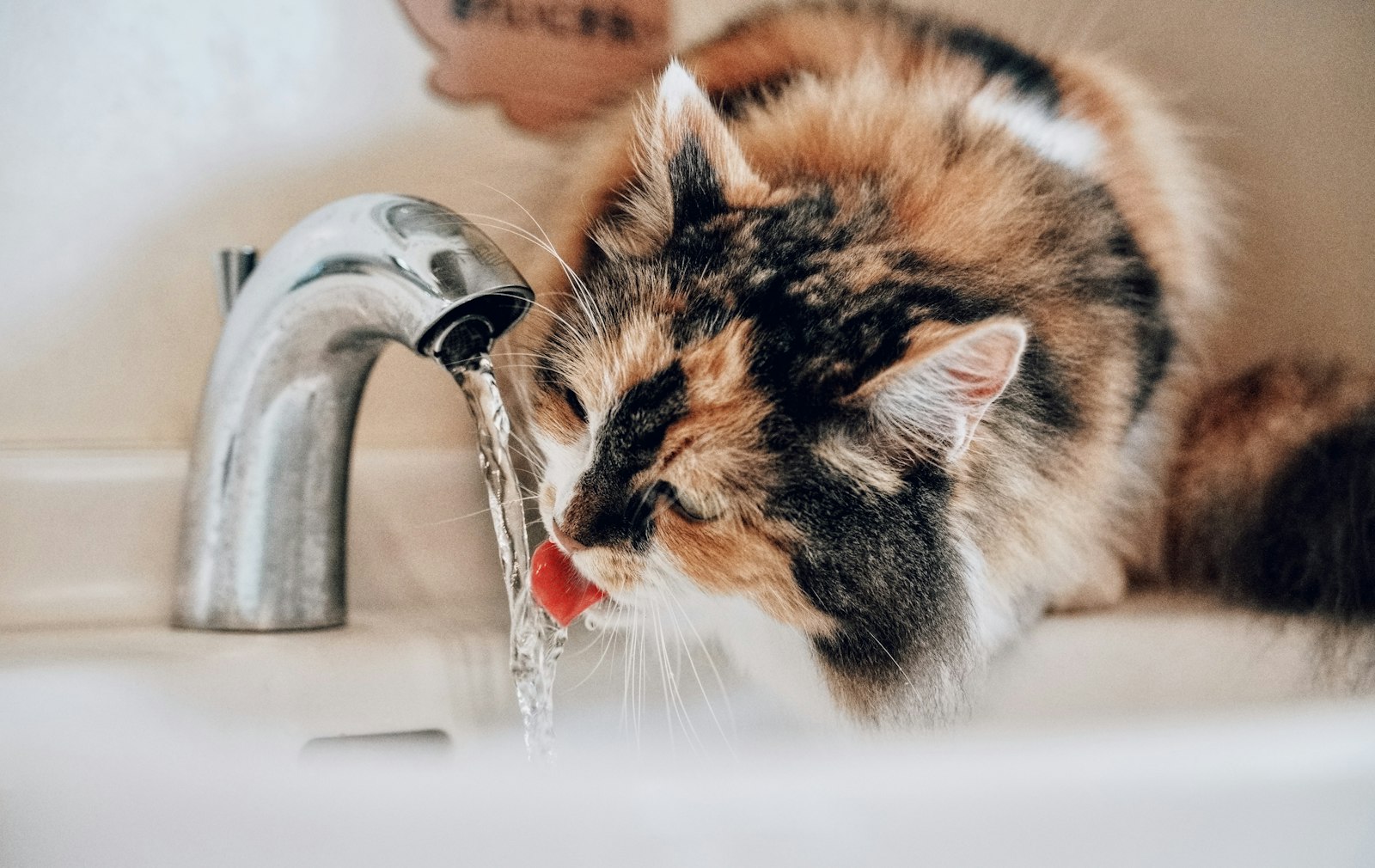
- Moving water signals freshness. In the wild, still water is more likely to be stagnant. Many cats — especially those that already drink from faucets — prefer a stream or ripple over a bowl.
- Wet food is still the bigger lever. A fountain encourages sipping; wet food delivers several times more water per meal than kibble (roughly 75% water versus ~10%). If urinary health is your goal, the ideal setup is both, which is exactly what we recommend in our guide to kidney disease in senior cats.
- Fountains are hygiene multipliers in both directions. A cleaned fountain beats a bowl; a neglected one is worse than either. Filters slow debris but do not replace scrubbing.
Set expectations accordingly: a fountain is a tool for a cat that likes moving water, not a medical device. If your cat ignores it after a fair trial, multiple plain water stations around the house deliver most of the same benefit.
Getting the Most From Your Fountain
- Place it away from food and litter. Cats instinctively avoid drinking near their prey-kill zone, and a fountain next to a litter box is self-defeating.
- Top up daily, deep-clean every 1–2 weeks. Disassemble fully, scrub with hot water and mild soap (or run dishwasher-safe steel parts through a cycle), and rinse the pump intake. Slime returns on a schedule; your cleaning should too.
- Replace filters on the calendar, not by appearance. Every 2–4 weeks for carbon filters. Keep a multipack on hand — running out of filters is how fountains get abandoned.
- Keep a bowl out anyway. The fountain is an addition, not a replacement. Some cats alternate, and a bowl is your backup during cleaning or a pump failure.
- Watch for the splash-pawers. If your cat plays in the water, put the fountain on a tray with a towel underneath and check the level more often — a dry pump dies young.
Frequently Asked Questions
Frequently Asked Questions
Are stainless steel cat water fountains better than plastic?
For hygiene, yes. Stainless steel resists scratching, and the bacteria-rich biofilm that makes fountains slimy colonizes scratches. Steel also holds no odors and is usually dishwasher-safe. Plastic fountains are cheaper and work fine, but they demand more rigorous, more frequent cleaning to stay sanitary.
How often should I clean a cat water fountain?
Refill daily and do a full disassembly and scrub every one to two weeks, plus a weekly rinse of the pump intake. Replace carbon filters every two to four weeks. A neglected fountain grows biofilm that can deter the very cat you bought it for — and in warm weather, clean even more often.
Do vets recommend water fountains for cats?
Many vets suggest them as one hydration tool, particularly for cats with a history of urinary issues or kidney disease, because increased water intake dilutes urine. They emphasize that fountains complement — never replace — wet food, multiple water stations, and, for diagnosed conditions, veterinary treatment.
Why did my cat stop using the water fountain?
The usual suspects, in order: it needs cleaning (cats reject stale or slimy water far faster than humans notice it), the filter is overdue, the pump has gotten louder, the water level ran low, or you moved it. Deep-clean and reset everything first — that resolves the majority of fountain boycotts.
Can a water fountain cause urinary problems in cats?
A properly maintained fountain helps prevent urinary problems by encouraging drinking. A neglected one can do the opposite: biofilm and bacteria in dirty fountains may contribute to urinary tract irritation. The fountain's effect on feline urinary health is really a referendum on your cleaning schedule.
How much electricity does a cat water fountain use?
Almost none — these pumps draw roughly 1–4 watts, comparable to an LED night light. At average US electricity rates, running one continuously for a year costs only a few dollars. There is no meaningful savings from turning it off, and constant circulation is what keeps the water appealing.
The Bottom Line
Any fountain on this list will get the job done if you keep it clean. If you want one answer: buy the Veken C1 Stainless for its full-steel hygiene and capacity, the Neareal if you want stainless at the lowest price, the PETLIBRO if easy pump cleaning is your priority, or the C1 Classic if you are testing the concept on a budget. Then put the money you would have spent on app features toward wet food — hydration is a diet game first, and a fountain is the supporting act.
Related reading: Kidney disease in senior cats: early signs & care · Cat straining to pee: when it’s an emergency · Best ceramic cat bowls of 2026 · Adopting a senior cat: the essentials