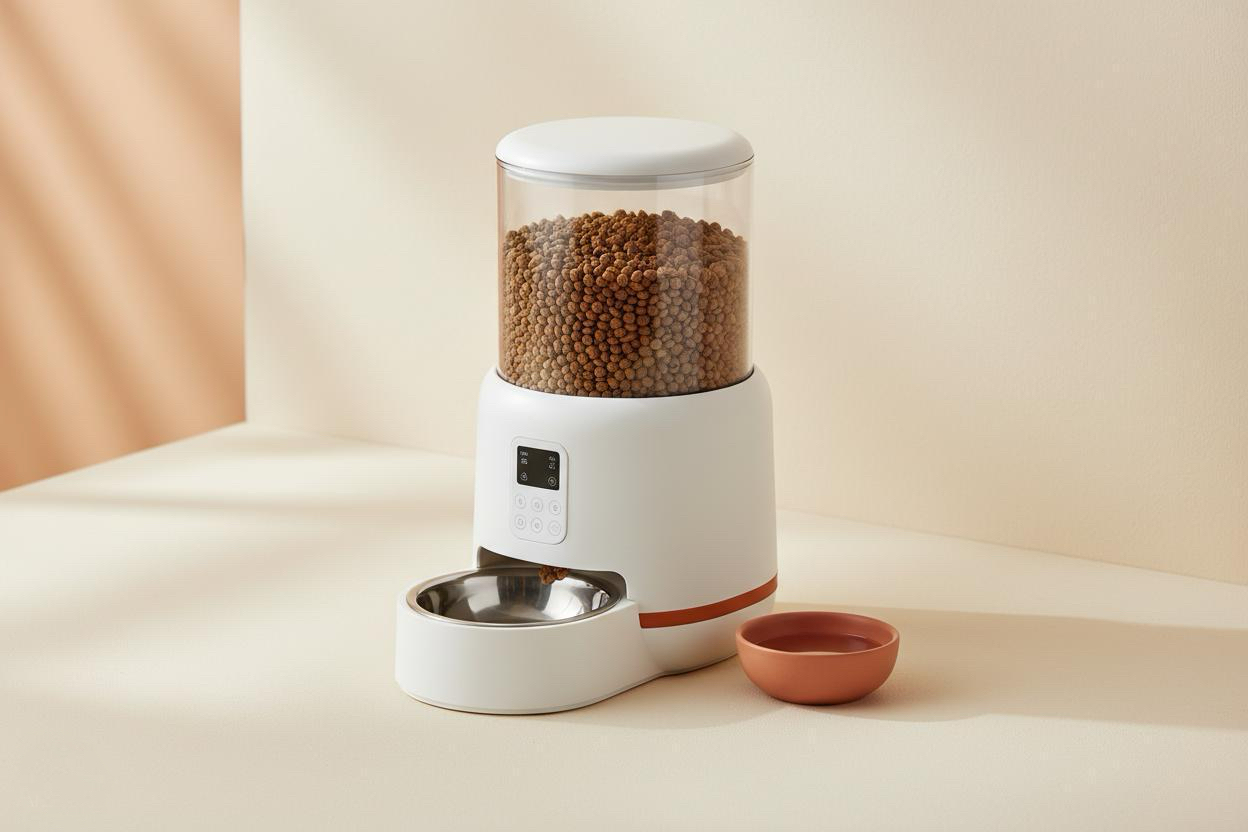
In August 2026, owners of a smart pet feeder woke up to cats and dogs missing scheduled meals. The cause was not a jammed motor or an unplugged cord — it was an outage of the feeder system’s online connection. Angry owners took to Reddit with a fair question: why does my pet’s food depend on an internet connection?
It’s the question every automatic-feeder buyer should ask before they spend a hundred-plus dollars on a “smart” model. Because the honest answer is: some feeders genuinely need WiFi to work, and some do not. Buying the wrong kind means your pet could be the one who goes hungry the morning your internet drops or a company’s servers hiccup.
This guide explains the difference, which common feeders survive an outage, and the one test you should run at home before ever trusting any feeder alone with your pet.
The short answer
Most automatic pet feeders do not need WiFi to feed your pet — but the ones that do are exactly the ones most likely to fail during an outage.
Two very different things get bundled under the label “automatic pet feeder”:
- Timed / offline feeders store their feeding schedule on the device. A battery timer flips a motor at the programmed hour, no internet required. If every server in the world vanished, these keep working.
- Smart / WiFi feeders add an app, remote control, and often a camera. The schedule may live on the device (in which case feeding survives an outage, though you lose remote monitoring) or in the cloud / depend on a live connection (in which case an outage can stop meals).
The catch is you usually cannot tell which kind you’re buying from the box. “App control,” “WiFi enabled,” and “smart” marketing language describes remote features — it does not tell you whether the feeding itself needs a connection. That distinction is the whole point of this guide.
Did the August 2026 outage affect every feeder?
No. The outage hit owners of the affected connected system — the exact failure mode this article warns about. Owners of simple battery-timer feeders (which have no WiFi to begin with) noticed nothing at all. That asymmetry is the strongest argument for an offline feeder if you want zero dependence on a company’s servers or your home network.
One nuance: several smart feeders store their schedule locally, so they also fed their pets during the outage — but their owners lost remote monitoring, alerts, and camera access until the connection returned, and they had no way to check in remotely. For a weekend away, “the food probably dispensed” is cold comfort when you cannot verify it.
The 3 feeder types, ranked by outage-proofness
| Feeder type | Feeds if internet down? | Feeds if power down? | Remote check-in? | Example |
|---|---|---|---|---|
| Battery timer (no WiFi) | ✅ Yes | ✅ Yes (with batteries) | ❌ No | Cat Mate C500 |
| Smart feeder, schedule stored on device | ✅ Yes | ⚠️ Only if battery backup | ✅ Yes (when connection is up) | PETLIBRO Granary |
| Smart feeder, schedule/feeding requires cloud | ❌ No — can miss meals | ❌ Depends on connection | ⚠️ Usually no when down | (some cloud-first models) |
The most outage-proof option is a battery-powered timer feeder: it has no WiFi to lose and keeps working through a power cut as long as batteries are fresh. The trade-off is that you give up remote monitoring. The middle option — a smart feeder that keeps the schedule on the device and has battery backup — is the best of both worlds in theory, but only if you verify it actually feeds offline.
Our top pick for never-missing-a-meal
If your top priority is “the meal happens, no matter what,” this is the feeder to buy.
 Most Outage-Proof
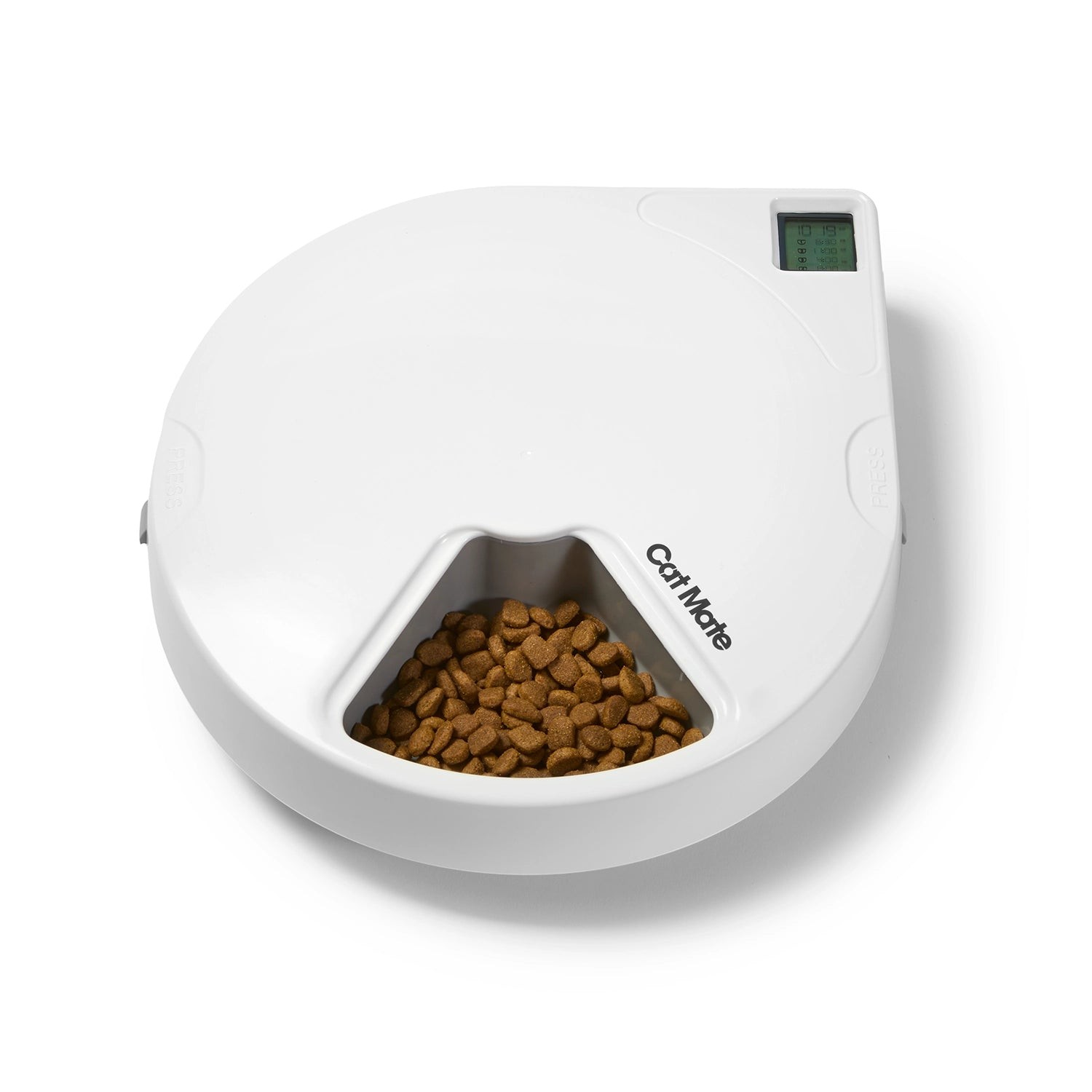
Cat Mate C500 Automatic Pet Feeder
Best For: Wet or dry food on a budget, outage-proof feeding, day trips
Material: Plastic with stainless steel bowl inserts
Capacity: 5 compartments
What We Like
- No WiFi or app to fail
- Runs on 3 AA batteries — keeps working in an outage
- Works with wet or dry food
- Dishwasher-safe trays
What We Don't Like
- Only 4 scheduled meals + 1 immediate
- Ice packs must be refrozen for wet food
- No remote monitoring
The Cat Mate C500 has no app, no WiFi, and no cloud — it is a carousel timer on three AA batteries. When the internet, the power, and the feeder company’s servers all fail, this feeder still rotates to the next compartment at the time you set. That is the whole appeal, and it is why we keep recommending it as the no-drama budget choice.
Its limitations are all about scheduling flexibility and monitoring, not dependability: four programmed meals plus one immediate feed, no way to see from your phone whether the cat actually ate, and wet food relies on the included ice packs (refreshed with refrigeration in a cool room). If those work for your routine, this is the single most reliable thing you can leave with your cat.
If you want cameras and remote feeding anyway
Smart features are not bad — they are just not a guarantee that feeding works. If you want a camera and app control, buy a smart feeder but verify it feeds offline before you rely on it, and know what you give up during an outage.
 Best if You Want a Camera
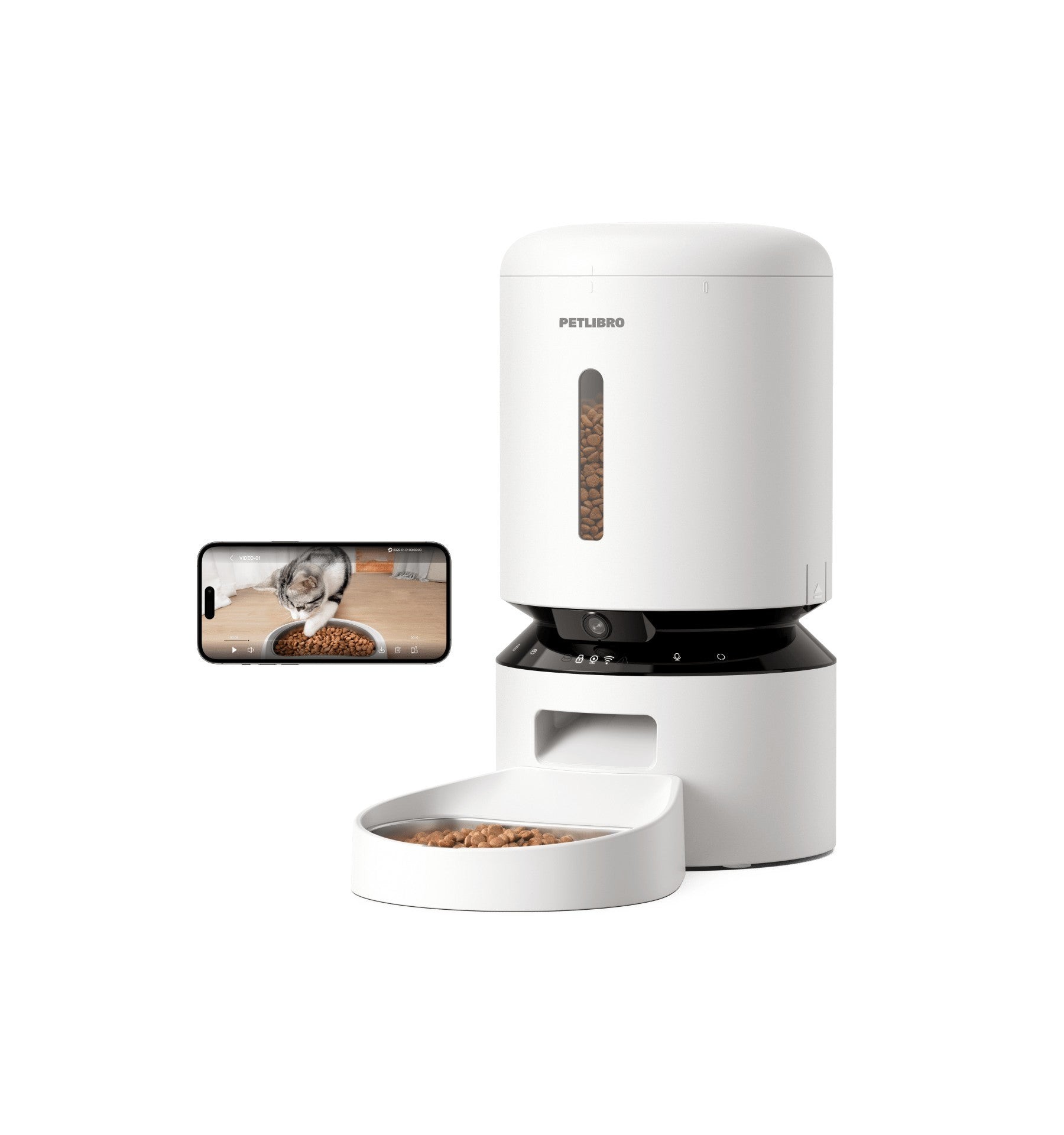
PETLIBRO Granary Camera Feeder (Dual Tray)
Best For: Two-cat households, remote monitoring, dry food
Material: ABS plastic with stainless steel bowls
Capacity: 5 L / 169 oz hopper
What We Like
- 1080p camera with night vision
- Feeds on local timer even if WiFi drops
- Dual food trays for two cats
- 5 GHz and 2.4 GHz WiFi
What We Don't Like
- Dry food only
- Cloud storage is paid after trial
- Loss of app + camera access during an outage
- App and camera add failure points
The PETLIBRO Granary Camera Feeder is our top pick in our full best automatic cat feeders review — for good reasons, including that its scheduled feeding runs on a local timer, so a mere WiFi drop usually does not stop the meals. But in an outage you lose the app, the camera, and the alerts: you cannot check from your phone whether your cat ate, and if the schedule depends on the cloud in your setup, meals can be at risk too. It is a great feeder if a camera matters more to you than absolute fail-safe simplicity.
The one test you must run before any trip
No matter which type you own, spend three days at home test-feeding before you leave your pet alone with it. Here is the outage-specific version:
- Unplug the feeder (or toggle its smart connection off in the app) while you are still home.
- Let it run your normal mealtimes for a day or two.
- Watch or check whether your pet actually gets fed on schedule the whole time.
If it feeds every meal while disconnected: the local timer works, and you can trust it for trips — subject to power backup. If meals stop the moment it loses its connection, you now know the truth, and you need a backup plan (a second offline feeder, or a neighbor or pet sitter on call) before you leave.
This one test would have spared the August 2026 owners a lot of panic, and it protects against any brand’s outage — the ones we know about and the ones coming.
How to choose for outage-proof feeding
Before buying, work through these four steps so you never discover the risk the hard way.
- Ask “does scheduled feeding need a connection?” not “does it have WiFi?” Read the specs or owner reviews specifically for whether meals dispense on a local timer when disconnected. If the manual says the schedule is stored “in the app” or “in the cloud,” treat the feeder as connection-dependent until you test otherwise.
- Prefer battery power for absolute fail-safety. A battery-timer feeder (Cat Mate C500, and many WOPET/Cozila models) keeps working through both internet and power outages. A corded smart feeder needs battery backup at minimum — check it actually charges and holds.
- Decide whether you’re buying convenience or dependability. If remote feeding and camera check-ins are essential, accept the outage trade-off and buy a model you’ve verified feeds offline. If dependability is the point, an offline timer is simpler and cheaper and cannot fail that way.
- Keep a human or a second feeder as the ultimate backup. No feeder is a substitute for a check-in on trips longer than a weekend. The fail-safe philosophy is “the feeder handles the routine; a person handles the plan.”
FAQs
Frequently Asked Questions
Do automatic pet feeders need WiFi?
Not necessarily. Basic timed feeders like the Cat Mate C500 run on battery and an internal timer with no internet at all. Smart feeders add WiFi for app control, remote feeding, and cameras — but whether the feeding itself survives an outage depends on whether the schedule is stored on the device or needs the connection. Check the specs for 'local timer' and test it at home before relying on it.
What happens to a smart pet feeder when the WiFi goes down?
It depends on the model, and you should verify your specific one. Many smart feeders store the schedule locally, so scheduled meals still dispense when the internet drops — you just lose remote monitoring, alerts, and camera access from the app. A feeder whose feeding relies on a live connection or a company's servers can miss meals. Test by disconnecting yours at home for a day or two before any trip.
Will an automatic pet feeder work during a power outage?
Only if it has working battery backup. Corded smart feeders stop when the power does unless they have charged batteries installed. Battery-only feeders like the Cat Mate C500 keep working through an outage as long as the batteries are fresh — keep spares on hand.
Did the August 2026 smart feeder outage affect every feeder?
No. It hit owners of the affected connected feeder system. Owners of simple battery-timer feeders noticed nothing because those have no WiFi to go down. Even among smart feeders, models that feed on a local timer would have kept dispensing — though their owners lost remote monitoring until the connection returned.
Which automatic feeder is most reliable if the internet goes down?
A battery-powered timer feeder with no WiFi, like the Cat Mate C500, is the most outage-proof: it has no connection to lose and keeps working through power cuts with fresh batteries. Its trade-off is limited scheduling (a few timed meals) and no remote monitoring. If you want smart features, buy a model you've verified feeds on a local timer offline.
The bottom line
An automatic feeder is a convenience, and convenience should not become a single point of failure for your pet’s meals. The August 2026 outage was a public reminder that “smart” and “connected” are features — not guarantees that your pet gets fed.
The fail-safe choice is simple: a battery timer feeder has no WiFi and no cloud to go down, and it is usually the cheaper option too. If you want cameras and app control, buy a smart feeder, but verify it feeds offline before you trust it, keep battery backup installed, and always have a person on call as the real backup.
For more help choosing, read our full best automatic cat feeders of 2026 review, or use our cat age calculator to pin down your cat’s life stage and adjust their feeding schedule accordingly.